
Thinking partner · not a sermon mill
A partner for the sermon you’re already thinking.
A thinking partner that helps a preacher build sermons in his own voice, on deadline, without cheating.
- Your voice, earned over time (context warmth)The cell listens across sermons and remembers how you preach.
- Help starts at zero every session (drafting dial)It opens asking questions, not writing. You decide if it goes further.
- Verified KJV scripture spine (AI optional, never required)Every verse is looked up in a local, exact text — never invented.
The week you already know
None of this is a failure. It’s the rhythm of the work.
Preaching every week is a discipline with its own weather. Sermon Cell is built for the weather — not to shame you out of it.
Monday–Thursday
The week comes in pieces
A line in the car. A thought over coffee. A verse that will not let go — and nowhere to put any of it before it’s gone.
The text
The passage starts to own you
You read it, and read it again, and the more you look the less sure you are where it’s going. The clock keeps its own counsel.
The draft
The ramble sets in
Three good ideas and no through-line. Pages that circle. You know there’s a sermon in here; you just can’t hear its spine yet.
The shortcut
And the tools would just write it for you
Which is exactly the fear — that the words in the pulpit wouldn’t be yours. So the blank page wins, and the honest tool sits unused.
Saturday night
And Sunday does not move
You’ll finish it. You always do. But it costs the evening, and the family, and a little of the joy that first pulled you to the text.
The integrity mechanism
Two dials. You hold both.
One dial is how well the cell knows your voice — it warms over time as you add material. The other is how much help you want on this sermon, right now. It resets to zero every session, so it can never quietly drift into writing for you.
The help ladder — each step up is a choice you make
Questions only · default · writes nothing
Surfaces what the text says and exposes the gaps. If you’re truly stuck, one short nudge — then back to questioning.
Aids · you write every word
Illustrations, structure drawn from your own proven shapes, exegesis pointers, verified cross-references.
Draft a passage · you edit
From your notes, in your voice, it drafts the single passage you ask for. One passage — the one you name.
Full draft · you edit every line
From your points and notes, a full draft in your voice and your tradition’s shape — a starting block, not a finish line.
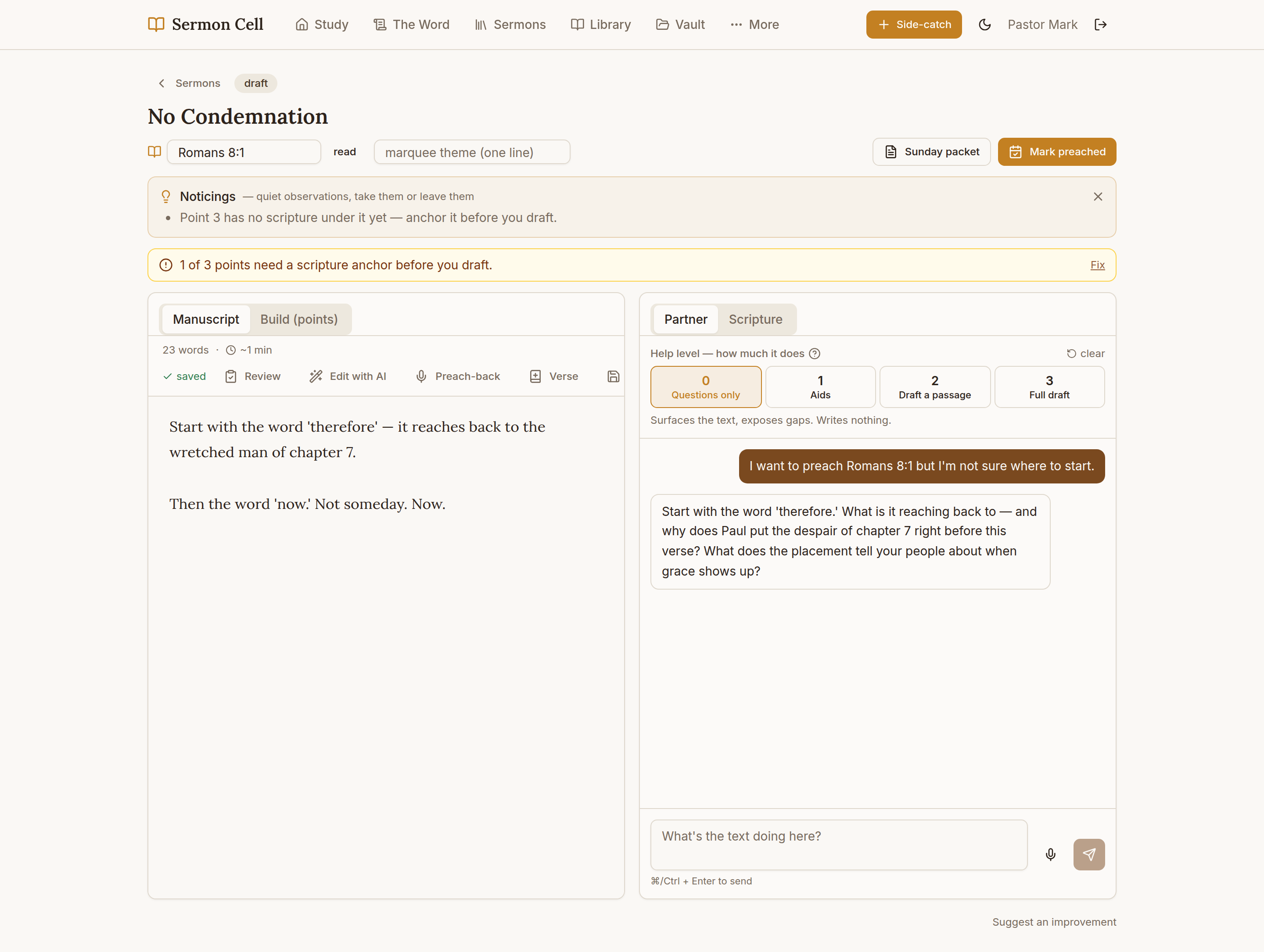
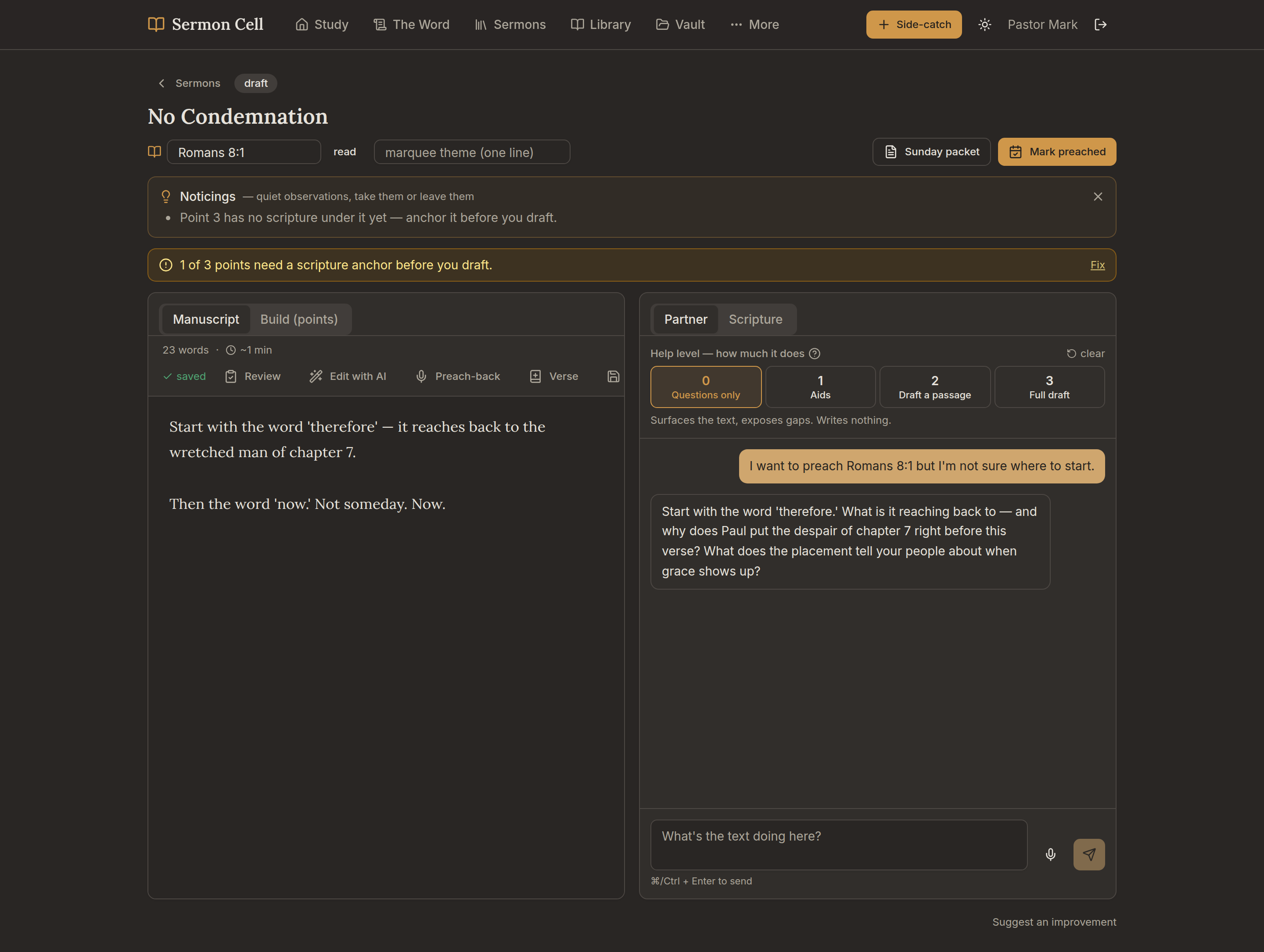
The workspace: your manuscript on the left, the partner and the help dial on the right. The dial opens at 0.
Not a sermon mill
It will not write your sermon for you. That’s the point.
The manuscript is yours. The cell never writes there unasked, and when you do ask for an edit, it only ever proposes — you see the change and accept or reject it. There is no silent overwrite.
Type a topic, get a finished sermon.
Bring your thinking; leave with your sermon — in your words.
The machine’s voice in your pulpit.
Your voice, earned over time and kept.
It silently overwrites your draft.
Every AI edit is confirm-first — you see a before/after and accept or reject.
You’re handed words you never chose.
You forge the pulpit words. Nothing reaches the manuscript unasked.
How it works
Talk → Ask → Forge
Talk
Think out loud with a partner who’s read the text. It asks the questions that find your through-line — and never puts words in your mouth.
Ask
Anchor each point to a verified verse before you draft it. Turn the help dial up only as far as you want, only when you want it.
Forge
Write the manuscript in your own hand. Snapshot versions, catch stray ideas, and export a Sunday packet when it’s ready to preach.
Three surfaces
Where the work happens
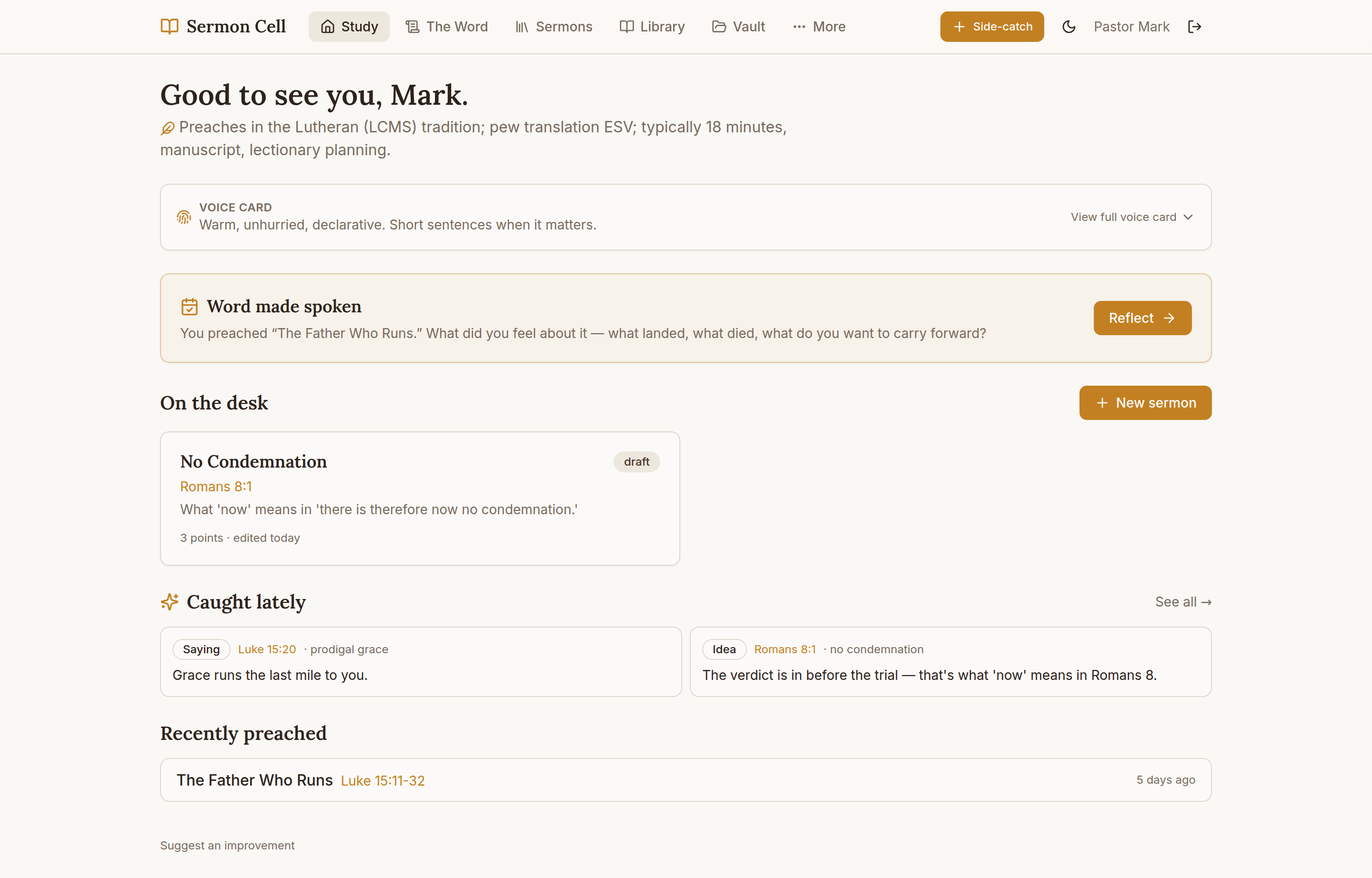
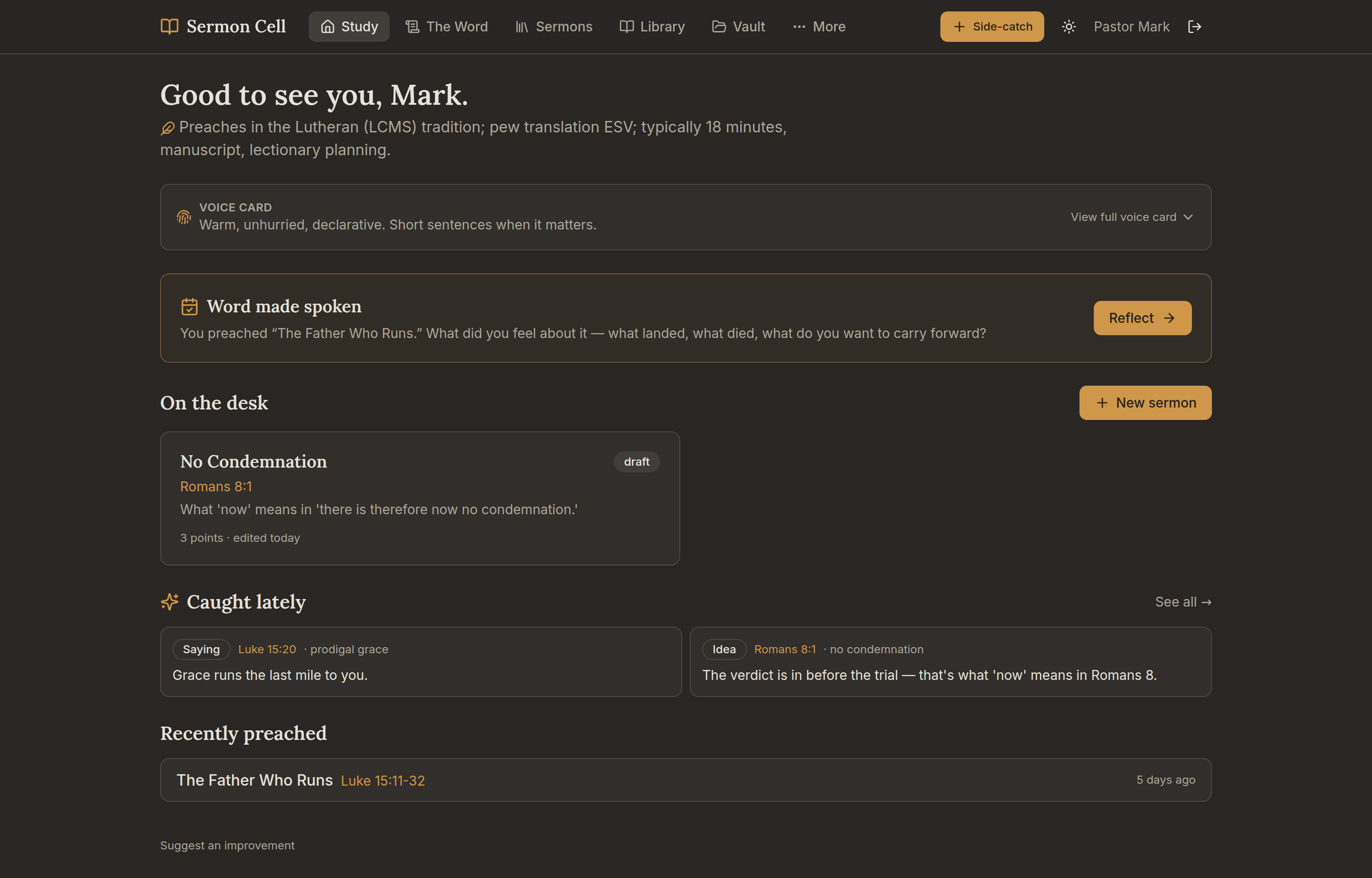
The Study
Your home. It greets you by name, remembers something about you, and surfaces — at the seam, never mid-thought — the drafts on your desk and the ideas you’ve caught.
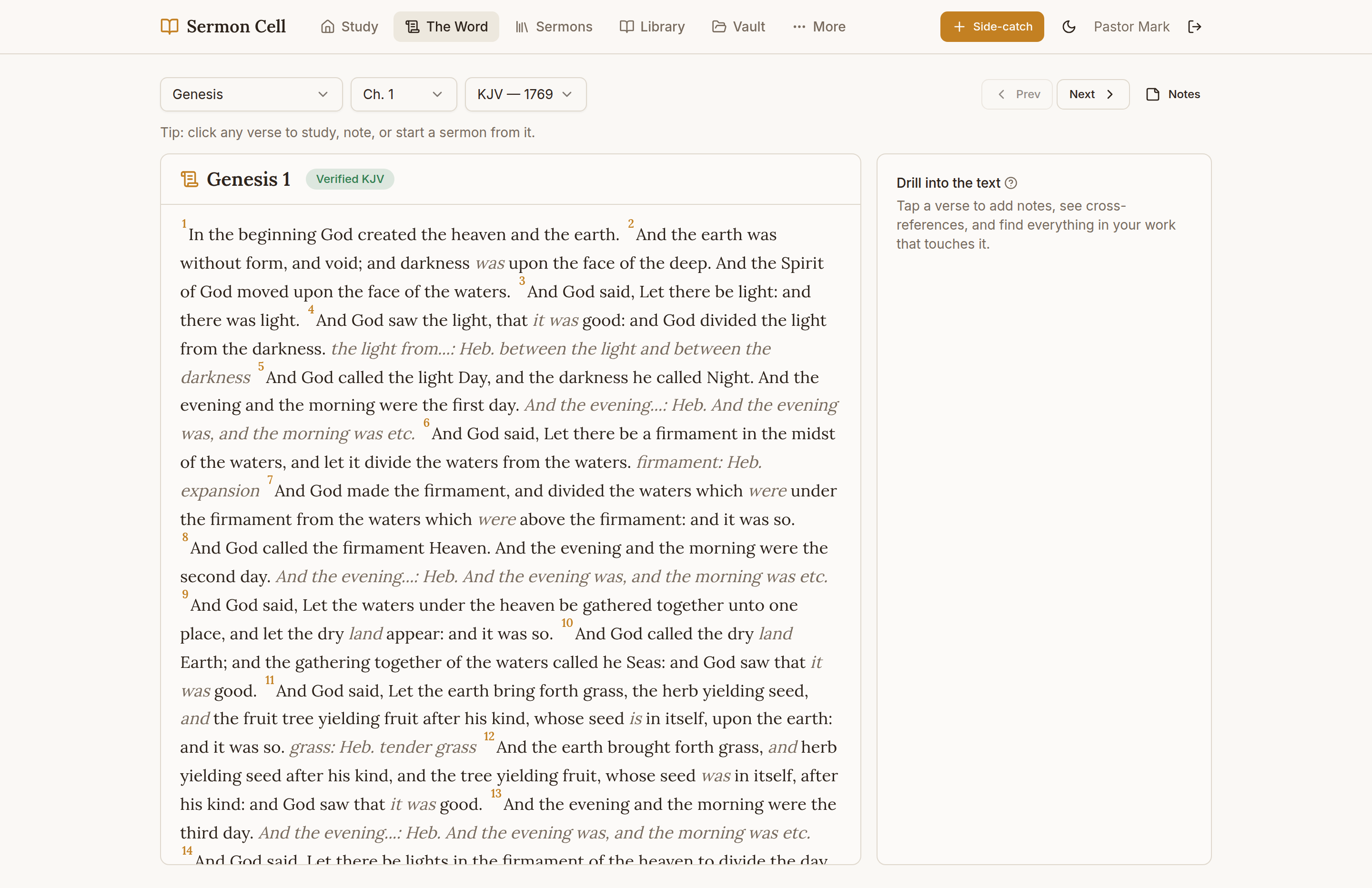
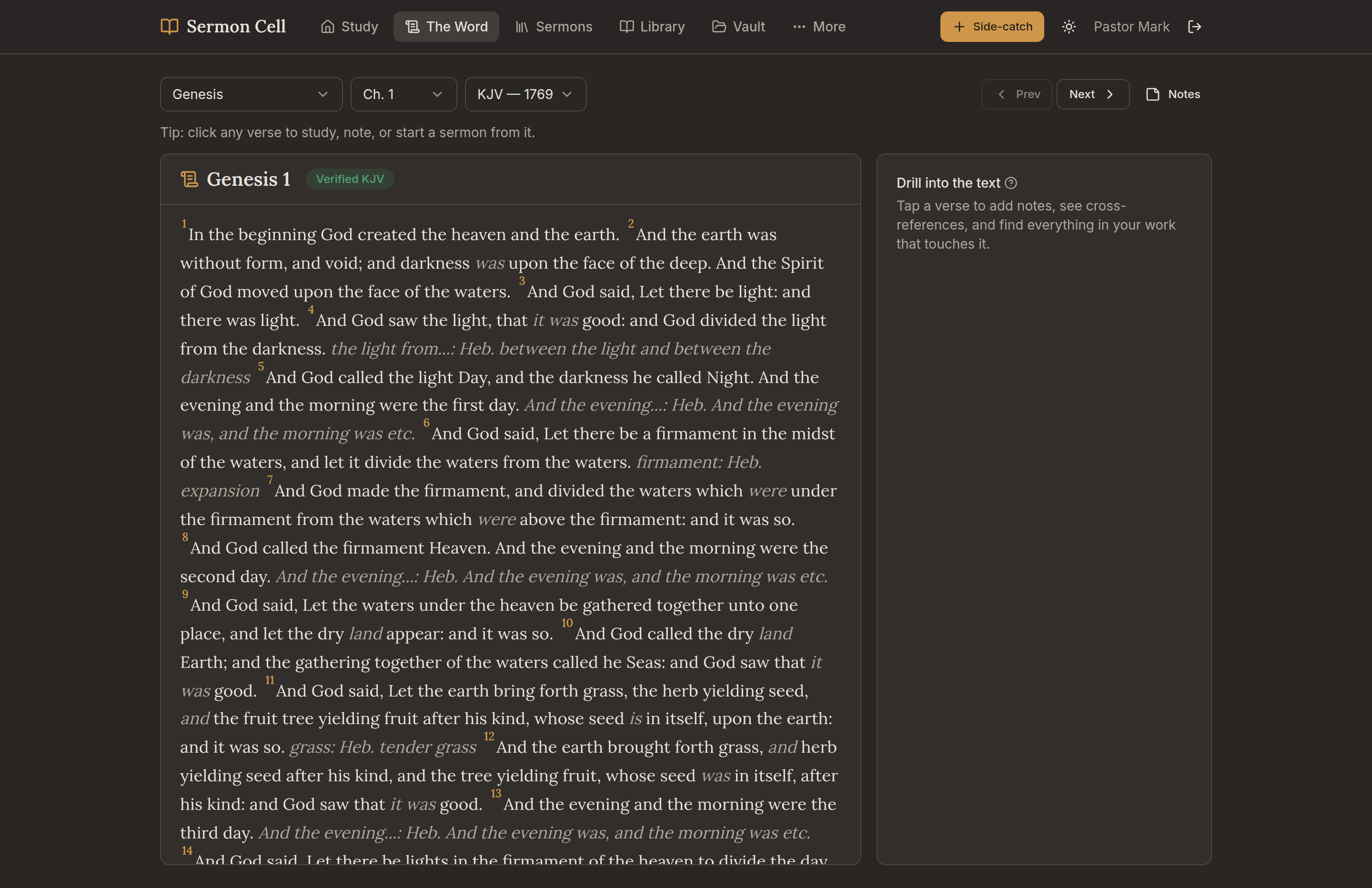
The Word
A full, readable KJV that doubles as the hub: read the source, highlight and annotate it, and see everything you’ve ever built on a verse.
The Workspace
The two-surface study for a single sermon: your manuscript on the left, the partner and Scripture on the right.
What’s inside
Built for the whole week, not just the blank page
Verified scripture spine
A local, exact KJV — 31,100 verses — plus vote-weighted cross-references. The cell can only quote what the text actually says; references that don’t resolve are refused, not invented. Anchor every point to a verse before you draft it.
Law & Gospel lenses
Optional editorial lenses brief the partner in your tradition’s frame, so the help you get reads the text the way you do.
Side-catch
Quiet capture that never interrupts. File a pulpit saying, a theme, or a concept link mid-week; it surfaces later at a seam, never mid-thought.
Filing & “have I preached this?”
Mark a sermon preached and it’s dated and archived. Every delivery date is kept, so you always know what you’ve said, and when.
Sunday packet
One-tap export of the sermon in a clean, preachable form when it’s ready to carry into the pulpit.
Voice fingerprint
Paste past sermons and answer a few reflective questions; the cell builds a voice card — traits, register, the texts you return to — and grows it as you add material.
Preach-back
Speak the sermon and talk it through — an honest dialog that reflects it back to you, not a teleprompter reading it for you.
Drag-and-drop Library
Drop in PDF, Word, text, or Markdown — past sermons and study material — to deepen how the cell hears your voice.
Why you can trust it in the pulpit
Ownership, all the way down
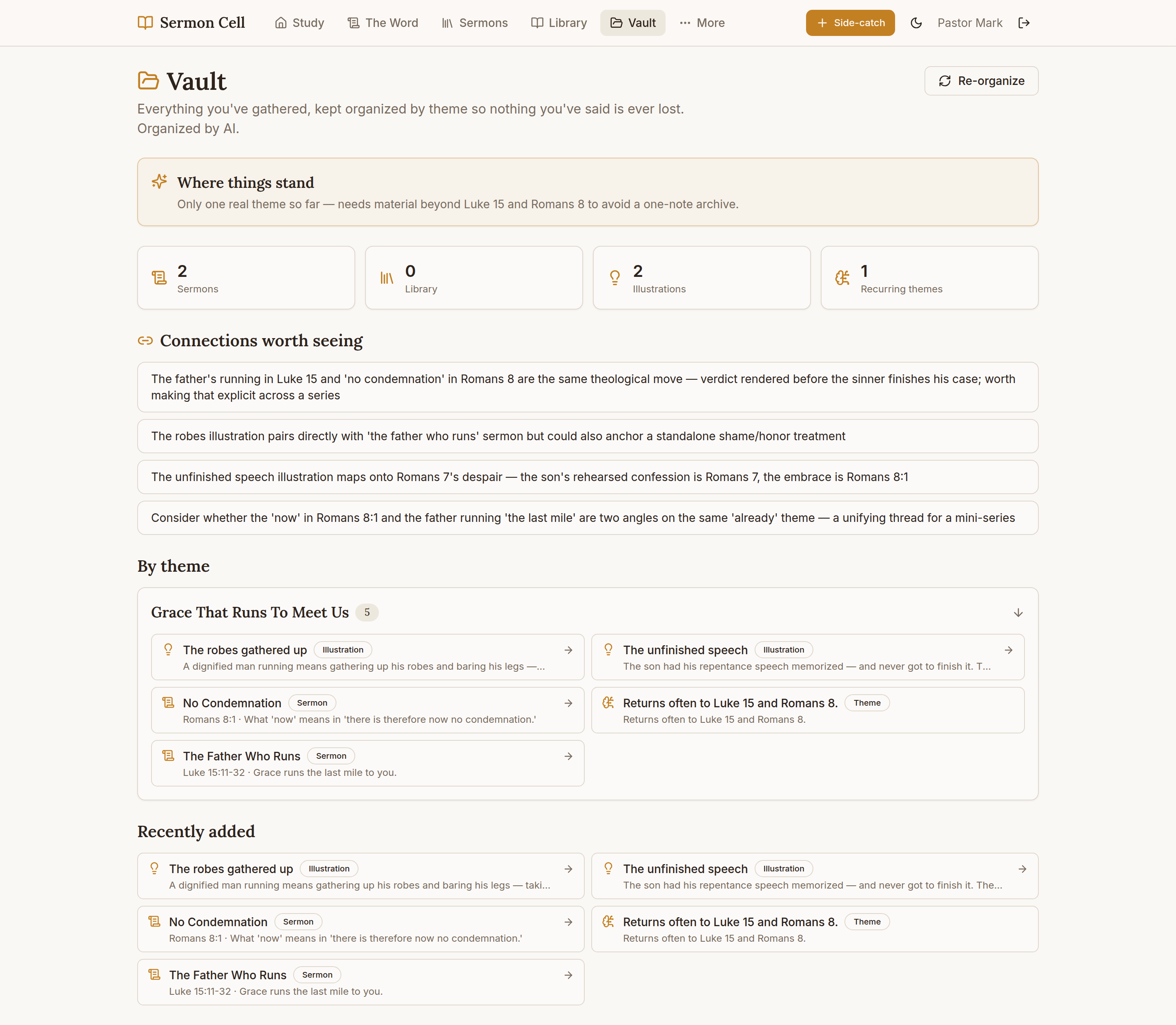
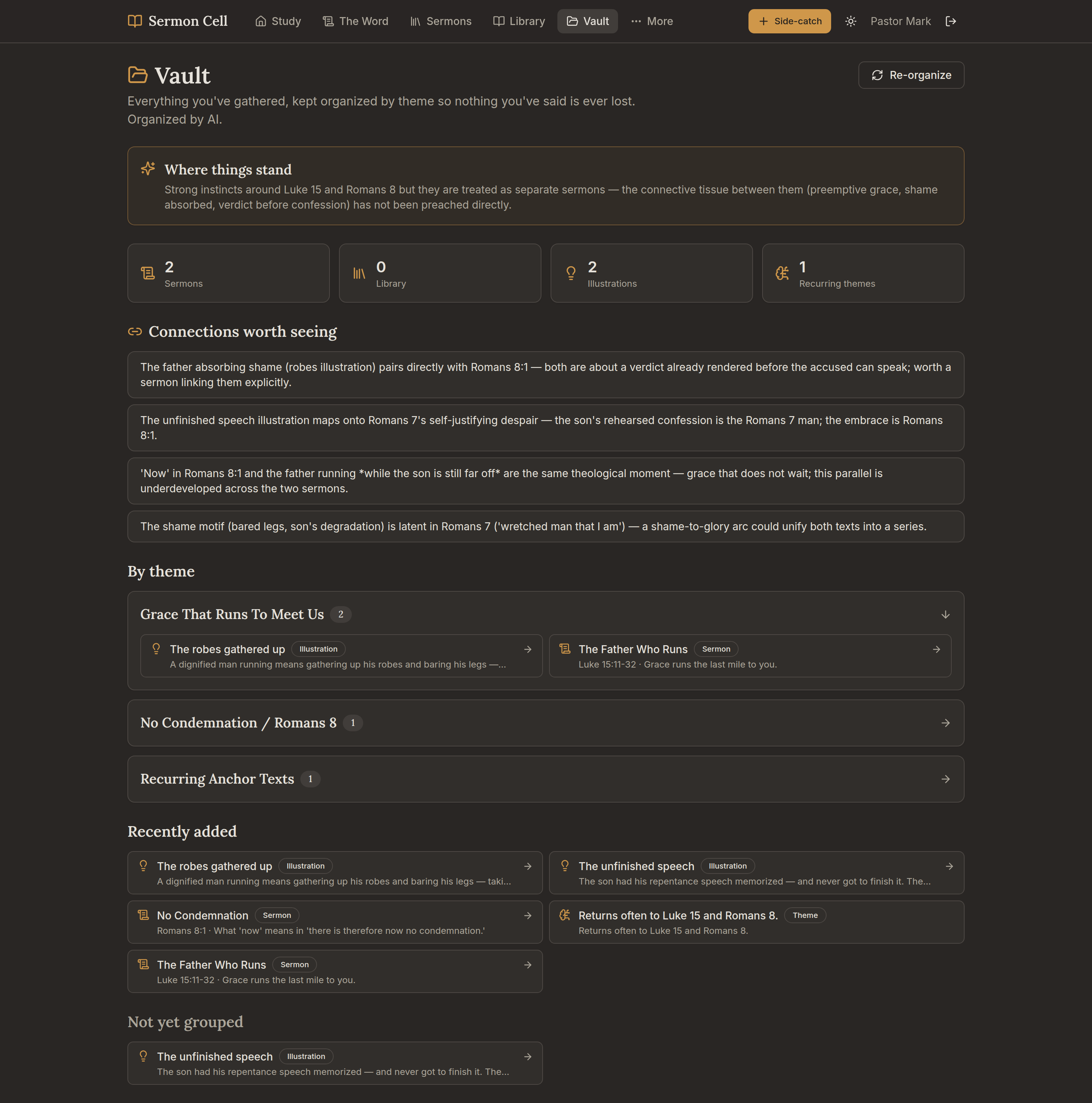
- Your voice, and your memory of Sunday
- The cell learns how you preach and remembers what you’ve delivered — so it meets you where your ministry actually is, not a generic pulpit.
- Verified Scripture, never hallucinated
- Every verse is looked up in a local, exact text and carries a “Verified KJV” badge. What can’t be found is refused, not invented.
- The non-AI tools are unlimited
- Reading, annotating, drafting by hand, filing, side-catch, the Sunday packet — none of it is metered, and none of it needs AI turned on.
- AI is optional, never required
- Turn it off and you have a full study. Turn it on and you have a partner. Either way, the words in the pulpit are yours.
Honest answers
The questions preachers actually ask
Isn’t using AI to preach just cheating?
Not the way this is built. The manuscript is yours; the cell never writes there unasked. Every AI edit is confirm-first — you see a before/after and choose to accept or reject. The help dial starts at zero every session, where it writes nothing at all. You forge the pulpit words.
Will it make my sermons sound like generic AI?
It works from your voice, not a template. Paste past sermons and answer a few reflective questions and it builds a voice card that grows over time; at levels 1–3 it drafts in your voice and your tradition’s shape. And you edit every line — so what people hear is you.
Can I trust the Scripture and translations?
The reasoning backbone is a local, exact KJV, and the cell can only quote what that text says — references that don’t resolve are refused. Alongside it you can read four more public-domain translations (WEB, ASV, YLT, BBE). Copyrighted modern translations aren’t redistributable, so they aren’t included, but the KJV remains the verified spine.
It’s Saturday night and I’m stuck. Does it help?
Yes — without taking the sermon out of your hands. Turn the dial up to draft a passage from your notes or a full first draft from your points, then edit it into your voice. Your live draft autosaves, so you never lose the Saturday-night work.
Bring the sermon you’re already thinking.
A colleague in the study — for the whole week, not just the blank page. Your voice, your Scripture, your call on every word.